
Optimizing Granule Composition in Fertilizers with LIBS
The composition and internal structure of fertilizer granules play a crucial role in their effectiveness and consistency. With LIBS, it’s possible to not only quantify essential elements but also explore how these elements are spatially distributed within a single granule.
In this case study, Sci-Trace was used to investigate granulated fertilizers produced under different processing conditions. The goal was to evaluate how production parameters affect the internal chemical structure and distribution of nutrients.
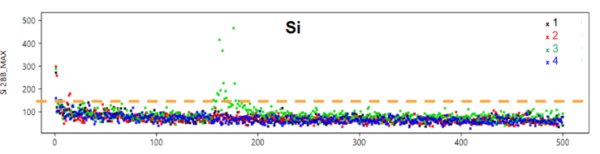
One of the key findings was that the concentration of selected elements—such as magnesium—varies depending on the compression pressure used during production. By profiling the granule surface layer by layer, we observed clear differences in magnesium signal intensity between samples pressed at higher pressure (A) and those compressed at lower pressure (B). This suggests that production pressure directly influences how deeply nutrients are embedded within the structure, potentially affecting nutrient release behavior.

In addition to magnesium, the LIBS analysis enabled detection of other macronutrients such as nitrogen and calcium, as well as trace elements that are often considered undesirable, including aluminum and silicon. The ability to perform depth-resolved analysis provided valuable insight into how these elements are distributed throughout the granule. For example, some elements showed higher concentrations near the surface, while others were more evenly dispersed, which may be relevant when evaluating nutrient availability or manufacturing consistency.


To complement the depth profiles, 2D chemical mapping was performed on physically sliced granules. This approach allowed us to visualize the planar distribution of key elements such as aluminum, carbon, nitrogen, and manganese. The resulting elemental maps highlighted differences in homogeneity and localization—key factors that can influence the overall performance of the fertilizer. Such mapping can also assist in optimizing formulation strategies or identifying processing inconsistencies.
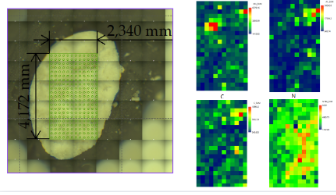
Sci-Trace proved particularly useful for detecting critical nutrients and contaminants without requiring any sample dissolution—granules can be examined intact or sectioned for detailed mapping. The combined power of depth profiling and 2D mapping allows for a comprehensive understanding of granule architecture, revealing how production parameters influence nutrient effectiveness and elemental dispersion.
This approach illustrates how LIBS supports advanced quality control and R&D efforts in fertilizer development—combining rapid analysis with detailed insight into granule composition and behavior.
Contacts
Contact Us
Take the first step to easier and speedier chemical analysis. Reach out to us and we will be in touch soon!
AtomTrace a.s.
Vědecko-technický park profesora Lista
Kolejní 9, Brno 612 00
Czech Republic
Identification number: 03396916
VAT: CZ03396916
E-mail: info@atomtrace.com
GDPR
Company AtomTrace a.s. is processing personal data. Information on the processing of personal data is available here.
Sales
Are you interested in our products?
Contact our sales team: sales@atomtrace.com
Support
Or contact our support team: support@atomtrace.com
 Handcrafted with love by STUDIO SYNAPSE