
Elevating Glass Industry with LIBS
In today’s glass industry, achieving high homogeneity of glass materials and precision in
defect identification or concentration determination of various elements is critical. Traditional
methods often involve lengthy and complicated procedures to analyze glass, require
complex sample preparation such as grinding them to the defect point or dissolving them in
chemicals, resulting in the process of measurement often taking several days.
Laser-Induced Breakdown Spectroscopy (LIBS) however emerges as a promising solution
that allows rapid and effective analysis of glass materials without the need for their
destructive processing or long measuring time. This was also evident in our recent
measurement study involving analysis of 5 glass samples for a customer. Our study focused
on three main areas:
1. Semiquantitative Determination of B, Li and Si
Using LIBS, we tested 3 different glass samples to determine boron, lithium and silicon
concentrations. Results showed varying amounts of these elements, correlating with their
expected applications. By employing different laser energies and environments such as
vacuum to stabilize the measurement, air and also argon to increase the signal intensity,we
have achieved easy and reliable methods for precise semi-quantification that could be
further expanded into classical quantitative analysis with the inclusion of additional
standards.
Analyzing the glass sample to identify its inhomogeneity with LIBS , we found twelve
elements with uneven distributions on the sample’s edge and center. Broad spectra revealed
not only uneven distribution of elements but also that specific elements (F and S) were
present only in the center, further contributing to the identification of the contaminant’s
origin. These findings demonstrate LIBS’ capability to detect material inhomogeneity and
identify contamination.

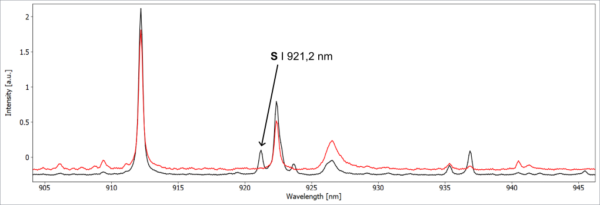
Distribution of F and S in sample’s center (black line)
3. Defect Identification
In the case of analysis for defect identification, LIBS effectively distinguished between glass
composition and defects. Using an optical microscope, the defect’s location was pinpointed,
and multiple laser shots were directed at the defect site, resulting in identifying zirconium as
base element of the defect from the furnace lining.

Presence of Zr in a glass sample (black line – glass; red line – defect)
LIBS proves to be an invaluable tool for the glass industry, enabling fast, precise, and
micro-invasive analysis of glass materials and ceramics. This technology not only enhances
production efficiency and material consistency but also facilitates quick and accurate defect
identification, such as pinpointing undesired elements in glass stoppers. Its capability for
direct and minimal sample preparation analysis stands out as a significant advantage,
particularly in detecting light elements and ensuring thorough quality control. Embracing
LIBS therefore promises to streamline processes, elevate product quality, and foster
innovation not only throughout the glass industry but also many others.
Contacts
Contact Us
Take the first step to easier and speedier chemical analysis. Reach out to us and we will be in touch soon!
AtomTrace a.s.
Vědecko-technický park profesora Lista
Kolejní 9, Brno 612 00
Czech Republic
Identification number: 03396916
VAT: CZ03396916
E-mail: info@atomtrace.com
GDPR
Company AtomTrace a.s. is processing personal data. Information on the processing of personal data is available here.
Sales
Are you interested in our products?
Contact our sales team: sales@atomtrace.com
Support
Or contact our support team: support@atomtrace.com
 Handcrafted with love by STUDIO SYNAPSE