
5 STEPS TO BUILD A HIGH-PERFORMANCE SCIENTIFIC LIBS SETUP
Brief introduction to the world of LIBS systems1. What devices do I need?
Everyone ever interested in LIBS method is familiar with the fact that the basic building blocks are a suitable laser and a detection system consisting of a spectrometer and a detector. But how to get orientated and understand the broad market of these instruments? Some basic guidelines are suggested in the next part. It is necessary to note that the particular products on the images shown below are just the illustrative examples of the described categories – not necessary the best or most suitable products for all scenarios.
Laser
Laser needs to be capable of inducing plasma from the analyzed material, i.e. it has to attain, albeit for a short time, high radiant power. Diode-pumped Solid State lasers (Innolas website, 2016)
For that reason the choice comes down to a pulsed laser with a pulse duration of tens of ns to tens of fs. Other parameters are laser wavelength, laser pulse energy, repetition rate and transverse energy profile. Price and size of the laser play key role together with its toughness and maintenance demands. The most common choice is still a solid state pulsed Nd:YAG laser with pulse duration in units of ns operating at its first or second harmonic frequency, corresponding to wavelengths of 1064 nm and 532 nm, respectively. Short wavelengths typically provide more effective ablation, lower background signal noise and less intensive matrix effect. While capable of maintaining required pulse energy, these lasers are bigger and more expensive thanks to worse conversion efficiency. Longer wavelengths are more easily absorbable by plasma and result in more intensive plasma emission. Apart from 1064 nm wavelength of Nd:YAG lasers there are available other wavelengths, such as 1.56um / 2.94 um of Er:YAG lasers, labeled in quite questionably as „eye-safe“.
It is worth mentioning that different materials possess different spectral characteristics of reflection/ absorption and it is therefore convenient to have a setup with capability to operate at various wavelengths.
Diode-pumped Solid State lasers (Innolas website, 2016)
For that reason the choice comes down to a pulsed laser with a pulse duration of tens of ns to tens of fs. Other parameters are laser wavelength, laser pulse energy, repetition rate and transverse energy profile. Price and size of the laser play key role together with its toughness and maintenance demands. The most common choice is still a solid state pulsed Nd:YAG laser with pulse duration in units of ns operating at its first or second harmonic frequency, corresponding to wavelengths of 1064 nm and 532 nm, respectively. Short wavelengths typically provide more effective ablation, lower background signal noise and less intensive matrix effect. While capable of maintaining required pulse energy, these lasers are bigger and more expensive thanks to worse conversion efficiency. Longer wavelengths are more easily absorbable by plasma and result in more intensive plasma emission. Apart from 1064 nm wavelength of Nd:YAG lasers there are available other wavelengths, such as 1.56um / 2.94 um of Er:YAG lasers, labeled in quite questionably as „eye-safe“.
It is worth mentioning that different materials possess different spectral characteristics of reflection/ absorption and it is therefore convenient to have a setup with capability to operate at various wavelengths.
 Nd:YAG laser with harmonic generators (Litron Lasers website, 2016)
Recently, affordable diode-pumped solid-state lasers (DPSS) have become available. In terms of pulse energies they generally cannot yet compete with common flashlamp (usually xenon discharge) pumped lasers, however, they offer wide range of advantages. Thanks to higher efficiency they require less powerful cooling, leading to more compact dimensions. They also offer an order higher repetition rates and beam profile approaching that of a perfectly focusable TEM00. Thus for many applications DPSS is an excellent choice. This holds similarly for pulsed fiber lasers, small microchip lasers, etc.
Nd:YAG laser with harmonic generators (Litron Lasers website, 2016)
Recently, affordable diode-pumped solid-state lasers (DPSS) have become available. In terms of pulse energies they generally cannot yet compete with common flashlamp (usually xenon discharge) pumped lasers, however, they offer wide range of advantages. Thanks to higher efficiency they require less powerful cooling, leading to more compact dimensions. They also offer an order higher repetition rates and beam profile approaching that of a perfectly focusable TEM00. Thus for many applications DPSS is an excellent choice. This holds similarly for pulsed fiber lasers, small microchip lasers, etc.
 Fiber laser (YPG Photonics website, 2016)
Particularly suitable for LIBS are double-pulsed lasers capable of generating two intensive laser pulses in a short time interval. It is therefore possible to realize double-pulse LIBS technique in collinear direction only, but only one laser is needed.
Unless the budget is too tight, modern ps and fs lasers are an interesting choice. Their short pulse removes material via so called cold ablation (thanks to Coulombian explosion). Heat deposition and thermal influencing of the surrounding material is much smaller than in a case of nanosecond pulses. Shielding of plasma does not occur or occurs minimally and the laser-induced plasma parameters are much more convenient in many aspects in terms of LIBS analysis. These lasers are very popular in the world of laser fabrication due to the precise shape of the ablation crater. But due to their cost these lasers, however, are becoming part of LIBS setups quite slowly.
Fiber laser (YPG Photonics website, 2016)
Particularly suitable for LIBS are double-pulsed lasers capable of generating two intensive laser pulses in a short time interval. It is therefore possible to realize double-pulse LIBS technique in collinear direction only, but only one laser is needed.
Unless the budget is too tight, modern ps and fs lasers are an interesting choice. Their short pulse removes material via so called cold ablation (thanks to Coulombian explosion). Heat deposition and thermal influencing of the surrounding material is much smaller than in a case of nanosecond pulses. Shielding of plasma does not occur or occurs minimally and the laser-induced plasma parameters are much more convenient in many aspects in terms of LIBS analysis. These lasers are very popular in the world of laser fabrication due to the precise shape of the ablation crater. But due to their cost these lasers, however, are becoming part of LIBS setups quite slowly.
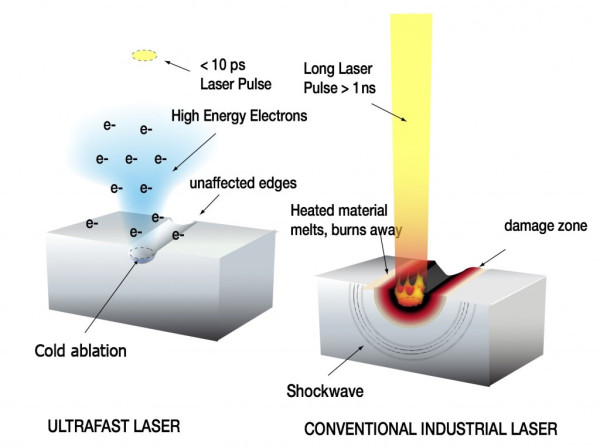 Nanosecond vs femtosecond ablation (image borrowed from Attodynelasers website, 2016)
Contacts
Contact Us
Take the first step to easier and speedier chemical analysis. Reach out to us and we will be in touch soon!
AtomTrace a.s.
Vědeckotechnický park kongresák.space
Hlinky 487/35, Pisárky, 603 00 Brno
Czech Republic
Identification number: 03396916
VAT: CZ03396916
E-mail: info@atomtrace.com
GDPR
Company AtomTrace a.s. is processing personal data. Information on the processing of personal data is available here.
Sales
Are you interested in our products?
Contact our sales team: sales@atomtrace.com
Support
Or contact our support team: support@atomtrace.com
 Handcrafted with love by STUDIO SYNAPSE